Views
17

There is a certain honesty in field visits. The land does not exaggerate. It shows what is fragile, what is resilient, and what is quietly turning around.
On 22 February 2026, the annual site visit moved across Tamil Nadu from the semi-arid farms of Krishnagiri to the tidal mangroves of Chengalpattu and the sacred groves of Viluppuram. Time was also spent with members of the Irula community engaged in plantation-linked livelihoods.
What unfolded was not a checklist review. It was field evidence aligning with documented research soil, saltwater, culture, and income intersecting in real time.

Krishnagiris agrarian reality is defined by rainfall variability (approximately 800900 mm annually), borewell dependency, and small, fragmented landholdings.
A 2021 study titled Agroforestry Practices in Tamil Nadu A Boon for Farmers for Livelihood Security published on ResearchGate documents how diversified agroforestry systems in Tamil Nadu improve livelihood stability by integrating timber and horticulture species with annual crops.
The study highlights that agroforestry enhances soil organic carbon (SOC), moderates microclimate, and improves income resilience yet adoption remains constrained by irrigation access, regulatory bottlenecks in timber transit, and delayed returns from long-rotation species

Long-term agroforestry trials conducted by the ICAR-Central Agroforestry Research Institute (CAFRI) demonstrate measurable increases in soil organic carbon under tree-based systems compared to monocropping. Multiple ICAR field studies report SOC improvements ranging between 0.3%0.5% over sustained integration periods in semi-arid zones.
Research by ICRISAT further establishes that even marginal increases in soil organic carbon significantly improve soil water-holding capacity in dryland systems a crucial variable in districts like Krishnagiri where rainfall distribution is erratic rather than insufficient.
Walking through the Trees for Farmers® plots, this was visible. Rainwater was not escaping as surface runoff. It was being absorbed. The soil structure felt different looser, darker, more cohesive.
The same ResearchGate study and supporting agroforestry economic assessments by ICAR suggest diversified systems can improve income stability by 2040 percent compared to monocropping, particularly for small and marginal farmers. The layering effect is key:
Short-term: millet, groundnut
Long-term asset: teak and mahogany
These plantations are located near the Cauvery North Wildlife Sanctuary, where increasing tree cover contributes to biodiversity continuity in dry landscapes experiencing fragmentation.
Research describes it as livelihood security. In the field, it felt like reduced dependence on a single monsoon.
From inland farms, the visit moved toward tidal ecosystems in Chengalpattu.

Hydrodynamic modelling studies led by researchers including Mazda et al. (1997, 2006) and subsequent coastal resilience studies cited by the International Union for Conservation of Nature show that dense mangrove belts can reduce wave height by 5090 percent over relatively short distances, depending on species density and root complexity.
Species such as Rhizophora apiculata and Rhizophora mucronata were planted due to their prop-root architecture, which increases drag and dissipates wave force.

The estimate that nearly 75 percent of original mangrove cover has been lost is widely cited in global assessments including reports by the Food and Agriculture Organization (FAO, Global Forest Resources Assessment) and reinforced by the World Resources Institute in coastal ecosystem monitoring datasets.
Standing inside newly restored belts, the statistics translated into urgency. This was not aesthetic planting. It was climate adaptation.

Beyond the mangrove belt, seaweed rafts floated in shallow waters.
Livelihood diversification research conducted by the Central Marine Fisheries Research Institute (CMFRI) in Tamil Nadu has documented how seaweed cultivation provides supplementary income streams for coastal womens self-help groups, reducing reliance on capture fisheries and smoothing household income volatility.
CMFRI technical reports on Kappaphycus cultivation in Tamil Nadu highlight:
45-day production cycles
Increased household savings stability
Each bamboo raft here followed that model 12-foot frames, 20 rope lines, approximately 150 grams of seed material per tie.
What research frames as livelihood diversification, the women described as predictability.

Indias estimate of over 13,00014,000 sacred groves comes from documentation by the ENVIS Centre on Forest Genetic Resources and Tree Improvement under the Ministry of Environment, Forest and Climate Change.
Ecological research led by scholars such as Prof. M. Gadgil and studies published in journals like Current Science establish that sacred groves in peninsular India function as biodiversity reservoirs, often preserving endemic and threatened species absent in surrounding agricultural landscapes.
Research shows sacred groves:
Maintain cooler microclimates
Support pollinator diversity
In Viluppuram, 10,000 native trees across six species were planted within degraded grove patches strengthening a rare tropical dry evergreen forest ecosystem along the Coromandel Coast.
Here, conservation is not policy-driven. It is culturally embedded.

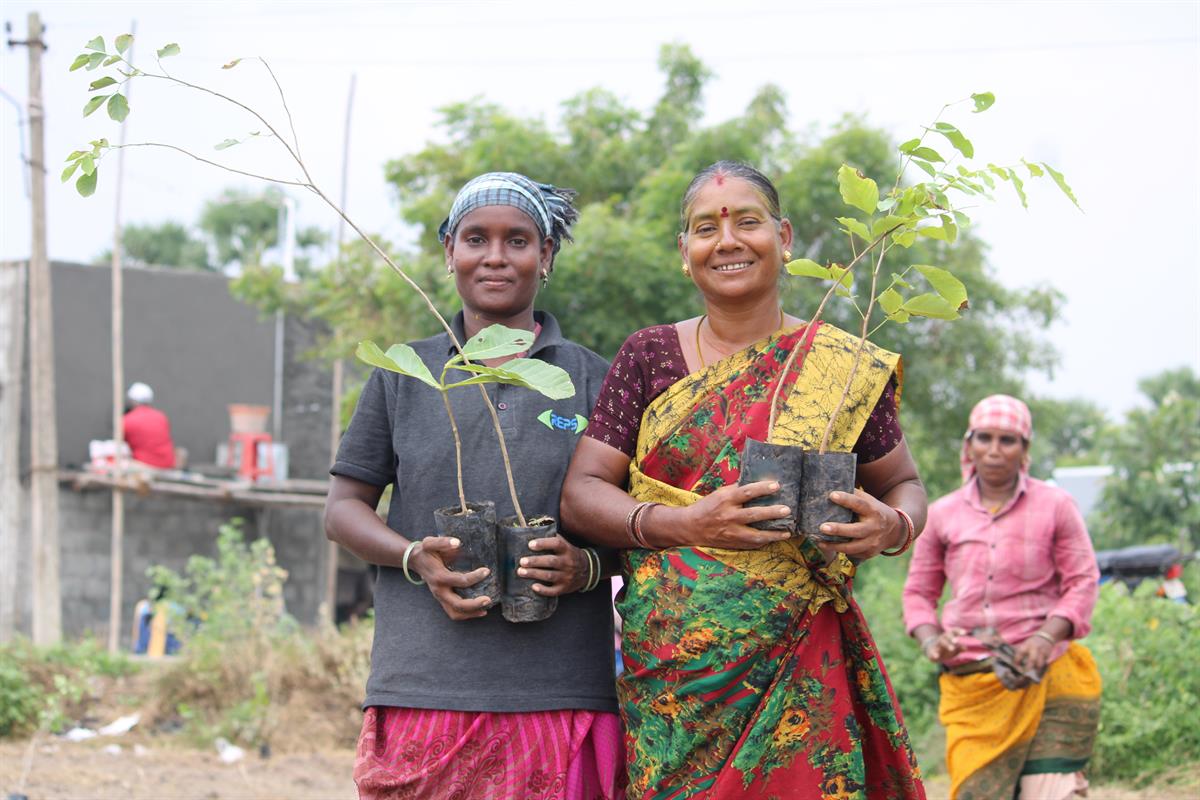
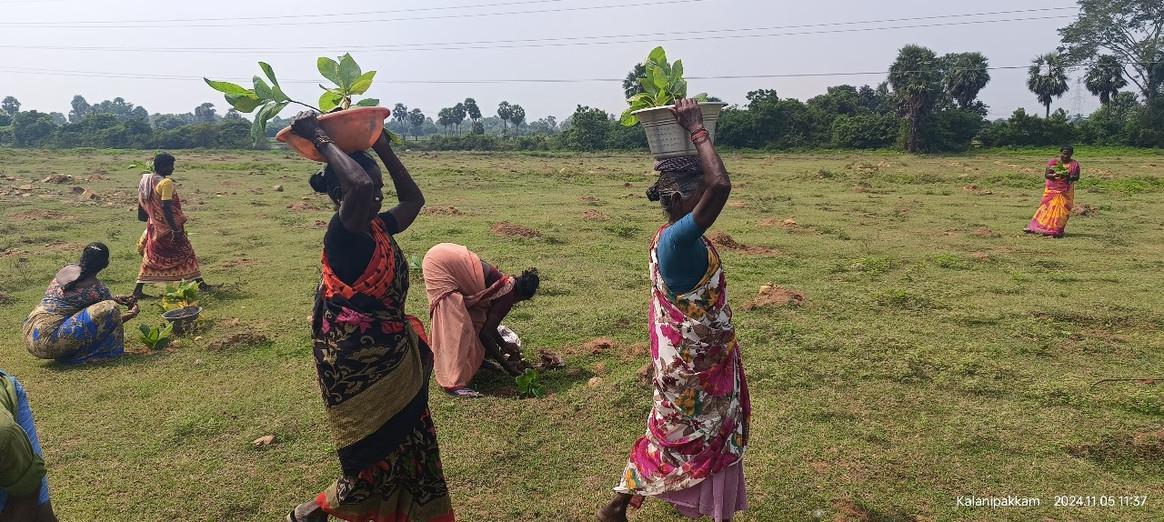
Among the Irula community, plantation-linked employment connects ecology with economic continuity.
Participatory forestry studies under Indias Joint Forest Management (JFM) framework documented by the Ministry of Environment, Forest and Climate Change indicate that structured afforestation programmes in tribal regions reduce seasonal migration and enhance asset creation when communities are directly involved in nursery raising, planting, and maintenance.
Species introduced guava, jackfruit, teak, mahogany, gamhar provide both ecological and economic returns. Under favourable conditions, teak and mahogany have shown growth up to nearly four metres within two years in monitored plantation sites.
Research describes this as community-based natural resource management improving livelihood indices.
On the ground, it looked like stable work and renewed land connection.
Across Krishnagiri, Chengalpattu, and Viluppuram, one pattern repeated:
Where ecological restoration is integrated with income design, outcomes are more durable.
The research exists. The data supports it.
But seeing it soil absorbing water, mangrove roots resisting tides, women planning harvest cycles, sacred groves regenerating carries a different weight.
This was not symbolic plantation.
It was research-backed restoration, unfolding in living landscapes.
Reference:
Agroforestry Practices in Tamil Nadu ResearchGate
https://www.researchgate.net/publication/352248494_Agroforestry_practices_in_Tamil_Nadu_India_-_a_boon_for_farmers_for_livelihood_security
ICARCAFRI Soil Organic Carbon Studies
https://icar.org.in
ICRISAT Dryland Soil Research
https://www.icrisat.org
FAO Global Forest Resources Assessment
https://www.fao.org/forest-resources-assessment
CMFRI Seaweed Cultivation Reports
https://www.cmfri.org.in
ENVIS Sacred Groves Database
http://frienvis.nic.in
Subscribe to our newsletter and recieve a selection of our cool articles every week.
Forest Conservation in India: What Happens When the Trees Are Gone?
Forest Conservation in India: What Happens When the Trees Are Gone?
Feb 06, 2026
Copyrights @ 2025 All rights reserved by Pangea EcoNetAssets Pvt Ltd.