
Views
15
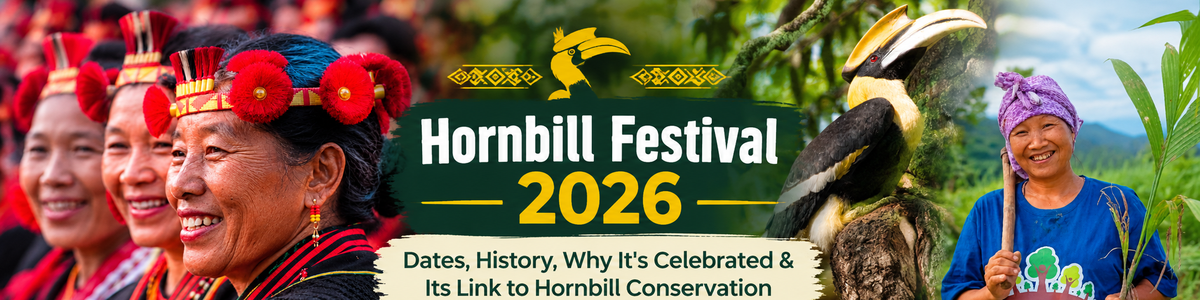
If you've ever wanted to see every tribe of Nagaland in one place, dressed in their finest, dancing, singing and cooking for visitors, this is the festival to plan for. Every December, the hills near Kohima fill with drumbeats, bamboo smoke and the smell of smoked pork as the Hornbill Festival brings the Naga people together for ten days of music, food, crafts and tradition. It's easy to see why it's nicknamed the Festival of Festivals.
But there's a quieter story behind the celebration. The festival is named after a bird that is finding it harder to locate the tall, old trees it needs to nest, as the forests around it keep shrinking.
In this article, we'll cover the history, venue, tickets, and timings of this Festival 2026, we'll look at how the festival, the bird and Nagaland's forests are connected.
Whether you're planning a trip or simply curious about the bird behind the name, here's all the information about the Hornbill Festival 2026 in one place, including how a single tree can help bring the hornbill back.
Hornbill Festival 2026 at a Glance
Quick Facts
What's new at the Hornbill festival 2026?
This year, the Hornbill Festival was set to get an early start with a special warm-up event in Delhi. Ticket to Hornbill, originally planned for 16 and 17 October at Talkatora Stadium, was supposed to bring together bands from across the country for a national band battle, with a ₹20 lakh cash prize pool up for grabs. The event has been postponed, and new dates haven’t been revealed yet. The winning band will still get a chance to perform on the Hornbill Music Festival stage. Back in Nagaland, the December celebrations will include village programmes, including one in Phek district on 3 and 4 December. The festival is also continuing its focus on sustainability, with officials describing it as a green festival and maintaining a plastic-free zone.
The Delhi event is an official initiative by the Government of Nagaland, presented through Tourism Nagaland and the Task Force for Music & Arts (TaFMA), which also plays a key role in organising the Hornbill Music Festival. The prize pool has support from several brands, with Casio India backing the cash prizes, while Furtados and Sennheiser are providing musical equipment worth ₹5 lakh. Together, that takes the total prize pool to ₹25 lakh. Tickets for the band battle were priced at ₹200, and entry to the opening evening was free.
Why is the Hornbill festival celebrated?

What is the Hornbill festival?
The Hornbill Festival is Nagaland's biggest cultural celebration, often called the Festival of Festivals. All the major Naga tribes come together at one venue to share their dances, songs, food, crafts and sports, so think of it as the whole state's festival calendar squeezed into ten days.
What is the purpose of the festival, and why is it important?
The festival exists to protect Naga heritage and bring the tribes closer together. Many traditions were slowly fading, so it gave them a stage and gave travellers a reason to visit. It matters economically too, as a 2021-22 state budget report noted that a modest spend on the festival brings back nearly ₹100 crore.
Why Is the Festival named after the Hornbill?
The hornbill appears in the folklore of most Naga tribes, and its feathers decorate warrior headgear. It stands for alertness, courage and grandeur, which is why it became the one symbol every tribe could agree on.
Who founded and who organizes the Hornbill festival?
The Government of Nagaland launched the festival in 2000, under then Chief Minister S.C. Jamir, with ₹3 crore from the Ministry of Tourism for the first edition and its infrastructure. Today the state's Tourism and Art & Culture departments organise it every year.
History of the Hornbill festival

Nagaland's agricultural festivals before hornbill
Before 2000, every tribe (The Angami, The Ao, The Lotha, a table including all other tribes and their respective festival is being provided below) celebrated its own festival at its own time, mostly around sowing and harvesting. The Angami have Sekrenyi, the Ao have Moatsu and the Lotha have Tokhu Emong, and since more than half of Nagaland depends on agroforestry, the farming calendar shaped them all.
How and why the festival started in 2000?
The history of the hornbill festival began in December 2000, when the first edition opened on 1st December as a small three-day event in Kohima. The idea was simple: bring every tribe's festival under one roof, encourage bonding between tribes and put Nagaland firmly on India's tourism map.
Why was Kisama heritage village built?
By the mid-2000s the festival needed a permanent home, so it moved to Kisama. The name comes from two villages, Kigwema and Phesama, and the morungs are laid out like a map of Nagaland, each placed roughly where its tribe's district sits.
How the festival has grown from 2000 to 2026?
From three days, the festival has grown into a ten-day showpiece. The 26th edition in 2025 drew over 2.1 lakh visitors, including around 2,500 foreign guests, and programs now reach six districts including Mon.
Hornbill festival location, dates and timings
Where is the Hornbill festival celebrated?
The Hornbill Festival location is Naga Heritage Village in Kisama, about 12 km south of Kohima, Nagaland's capital. Most visitors fly into Dimapur, 74 km away, and take a 2 to 3 hour taxi ride, while Kohima hosts many evening events.
Where will the Hornbill festival be held in 2026?
It will be held at Kisama again. The Hornbill Festival venue has hosted the event for years, and as a hornbill festival place, it's hard to beat, but book early, because officials admit, rooms and taxis run short in December.
Hornbill Festival 2026 dates and how many days it lasts?
The hornbill festival date never changes. It's 1st to 10th December every year, which in 2026 means Tuesday to Thursday of the following week. The first three days carry the biggest buzz, while 4 to 6 December tend to be calmer and better for photographs.
Hornbill Day: Opening day and Nagaland Statehood Day
Hornbill Day is the opening day, 1st December, which is also Nagaland Statehood Day, marking its formation as India's 16th state in 1963. Expect a grand parade, speeches and a mass tribal dance.
What are the timings for the Hornbill festival?
Hornbill festival timings are roughly 9 AM to 5 PM for cultural performances at Kisama, with music nights starting around 5:30 PM and Kohima's Night Carnival running later. The day-wise schedule is usually released in late November.
What Happens at the Hornbill Festival?
What do people do at the Hornbill festival?
Most visitors wander from morung to morung, watch dances on the central stage, shop for shawls and bamboo crafts, and eat their way through the stalls. A simple hornbill festival itinerary is one day at the arena, one in Khonoma village and one on the Dzükou Valley trail.
Morungs, performances, Naga wrestling and chilli contests
A morung is a traditional men's house built in each tribe's own style, where hosts serve food and show off their crafts. On the main stage, tribes perform war dances and folk songs, and crowds also gather for Naga wrestling and the king chilli-eating contest, with a chilli that crosses a million Scoville units.
Hornbill music festival and Kohima night carnival
Once the sun goes down, the energy shifts to the Hornbill Music Festival, with rock contests and live acts, while Kohima's Night Carnival adds food stalls, bands and late-night shopping. These hornbill festival events are why many young travelers now plan their trips around the lineup.
Naga food to try at the festival (including vegetarian options)
Try smoked pork with bamboo shoot, axone (fermented soybean) with sticky rice and the fiery king chilli chutney. Vegetarians have plenty of choices too, from bamboo shoot curry and boiled greens to rice and seasonal fruit, and every morung will tell you what's meat-free.
Which tribes are celebrated during the Hornbill festival? (Table)
Who is coming to the Hornbill festival 2026?
The full line-up for 2026 isn’t out yet, so keep an eye on Tourism Nagaland for announcements. The UK was a country partner in 2025. The winner of the Delhi band battle will also perform at Kisama, but the contest has been postponed, and new dates haven’t been revealed yet.
The Hornbill bird and its importance in the Naga culture

Why is the Hornbill important in Nagaland?
To the Nagas, the hornbill stands for courage and beauty, and its feathers crown warrior headgear. Hornbills also stay with one partner, which Nagas admire as loyalty.
Why is it called a Hornbill?
The bird's huge curved bill carries a horn-like, helmet-shaped bump called a casque, which is where the name comes from. Hornbills are also the only birds with their first two neck bones fused, which helps support that heavy head.
Which Hornbill species are found in Nagaland?
Nagaland is home to five of India's nine hornbill species: the great, wreathed, rufous-necked, oriental pied and Austen's brown hornbill. The rufous-necked hornbill is now mostly restricted to eastern Nagaland.
Is it lucky to see a Hornbill?
Many Naga stories treat the hornbill as a bird of honor, so spotting one is often seen as a good sign. It's also a sign of a healthy forest, because hornbills only stay where big old trees still stand.
Hornbills as "Farmers of the Forest": Seed dispersal and forest health
Hornbills eat fruit, travel long distances and drop seeds far from the parent tree, which is why researchers Margaret Kinnaird and Tim O'Brien call them the "farmers of the forest". A single bird can help grow an entire forest, which makes it an indicator species: when hornbills disappear, the forest is in trouble.
Is the Hornbill rare in India? Conservation status and threats

Is the Hornbill rare in India?
Some species are. The great hornbill is listed as Vulnerable on the IUCN Red List, and hornbills are protected under India's Wildlife Protection Act.
Why do Hornbills need large, old trees? (nesting cavities and fruiting trees)
Hornbills nest in natural cavities in big old trees, which take decades to form. The female seals herself inside while the male feeds her through a small slit, so without the right tree there are no chicks. Studies in Arunachal Pradesh found that great hornbills do better in unlogged forest than in logged forest.
Threats to Hornbills in Nagaland: Deforestation, Jhum Cultivation, Logging and Hunting
According to the India State of Forest Report 2021, Nagaland lost 235 square km of forest cover between 2019 and 2021. Logging of large trees, jhum (shifting) cultivation, encroachment, and hunting, all push hornbills out, and scientist Aparajita Dutta notes that protected areas alone won't be enough.
Can a festival celebrate the Hornbill and still protect it?
It can, as long as the celebration turns into action on the ground. Writers in Nagaland have called for long-term programs rather than one-time events, because a festival that celebrates the hornbill but doesn't help its forests grow back is only telling half the story.
How the Hornbill festival affects the environment and forests?
The environmental footprint of a 10-Day festival (Waste, Plastic, Traffic, Crowds)
More than 2 lakh visitors in ten days naturally means plastic bottles, food waste, and heavy traffic around Kisama. The state says it's working on a plastic-free zone, waste management, and a sustainability fund that tourists contribute to.
Why is forest loss a risk to Nagaland's festival and tourism economy?
If the hornbill disappears from Nagaland's forests, the festival loses its name, its symbol, and a good part of its ₹100 crore economy. Forest loss also brings floods and landslides, the kind of disasters Phek district already faces.
Community conservation in Nagaland: Khonoma, India's first Green Village
Khonoma, an Angami village near Kisama, shows what community-led conservation can do. In 1998, after about 300 Blyth's tragopans were killed in a week, the village council banned hunting and set up a 20 sq km sanctuary, and in 2005 India named it the first green village. It's proof of how forests and tribal communities protect each other. On similar lines, please refer our Nature News, “Where development meets nature. What the Great Nicobar Conservation teaches us.” https://www.grow-trees.com/blog/1181/when-development-meets-nature-what-the-great-nicobar-conversation-teaches-us
How to attend the Hornbill festival responsibly? (Plastic-Free, Eco-Friendly Travel)
A few simple habits go a long way:
- Carry a refillable bottle and a cloth bag.
- Share taxis and stay in local homestays.
- Buy crafts directly from artisans, and never buy feathers or wildlife products.
- If you choose hornbill festival camping, take every wrapper back out.
- Visit Khonoma and other villages with a local guide.
How restoring trees help save Hornbills: Forest restoration in Nagaland

Why restoring forests is the most effective way to protect Hornbills?
You can't protect a hornbill without protecting its home. Restoring forests brings back nesting and fruit trees together, and it steadies soil and water for people nearby too. Read more about why trees matter in protecting hornbills in our article.
Which trees do Hornbills need? (Oak, Chestnut, Black Cherry, Tamarillo)
- Oak: grows up to 90 feet, ideal for nesting, with fruit hornbills eat.
- Chestnut: can live for over a thousand years, with hollows that suit nests.
- Black cherry: a fast-growing pioneer tree with fruit hornbills love.
- Tamarillo: quick to grow and full of nutritious fruit.
Trees for Hornbills™ in Phek, Nagaland: What Grow-Trees is doing?

Grow-Trees.com's Trees for Hornbills™ project in Phek, Nagaland is restoring habitat in the villages of Thetsumi and Heningkunglwa, with a target of 60,000 trees to tackle habitat loss from shifting cultivation and logging. The same thinking drives our Trees for Tribals® project in Odisha, because trees last longer when local people are partners in growing them.
How you can help protect Hornbills and their forests?
- Plant a tree in the hornbills' forest.
- Choose responsible tourism, respect local wildlife guidelines, and skip single-use plastic.
- Support tree plantation and forest restoration projects.
- Protect old-growth forests and hornbill nesting habitats.
- Support community-led conservation initiatives in Nagaland.
- Avoid buying hornbill feathers and other illegal wildlife products.
- Spread awareness about hornbill conservation and forest loss.
- Support Grow-Trees.com's Trees for Hornbills™ project in Phek, Nagaland.
Plant a tree for Hornbills with Grow-Trees.com

Celebrating the hornbill festival is wonderful, but giving the bird a home is even better. Since 2010, Grow-Trees.com has planted over 20 million trees across 150+ projects, and you can plant a tree for hornbills online in just a few clicks. You can also explore our wider tree plantation projects across India.
Hornbill Festival FAQs
Where is the Hornbill Festival celebrated?
It's celebrated at Naga Heritage Village in Kisama, about 12 km south of Kohima, Nagaland.
What is the ticket price of Hornbill Festival?
The hornbill festival ticket price is usually ₹50 to ₹100 a day for Indian visitors, and foreign nationals may pay more.
Where will the Hornbill Festival be held in 2026?
The 2026 edition will be held at Kisama Heritage Village, near Kohima.
Is Hornbill Festival worth visiting?
Yes, if you enjoy culture, food and music, since all the major tribes are in one place. Book early.
How do I visit the Hornbill Festival?
Fly to Dimapur or take a train from Guwahati, then take a taxi to Kohima and Kisama. Indian visitors from outside Nagaland also need an Inner Line Permit.
What are the timings for the Hornbill Festival?
Cultural performances run from about 9 AM to 5 PM, with music nights after 5:30 PM.
Who founded the Hornbill Festival?
The Government of Nagaland founded it in 2000, under then Chief Minister S.C. Jamir.
Why is Hornbill important in Nagaland?
The hornbill stands for courage and beauty in Naga culture, and its feathers decorate warrior headgear.
What do people do at the Hornbill Festival?
People watch tribal dances, explore morungs, shop for crafts, try Naga food and enjoy the night music festival.
How many days does the festival Hornbill last in Nagaland?
It lasts ten days, from 1 to 10 December every year.
What is another name for the Hornbill Festival?
It's also called the Festival of Festivals.
Who organizes the Hornbill Festival?
The Nagaland Government's Tourism and Art & Culture departments organise it.
Which tribes are celebrated during the Hornbill Festival?
All 17 major tribes take part, including the Angami, Ao, Konyak and Lotha.
Why is the festival named after the hornbill?
The hornbill features in the folklore of most tribes and symbolises courage and grandeur.
What kind of hornbill bird is found in Nagaland?
Five species live in Nagaland: great, wreathed, rufous-necked, oriental pied and Austen's brown hornbills.
Is it lucky to see a hornbill?
Many Nagas consider it a good sign, and it also means the forest is healthy.
What is the purpose of the festival?
Its purpose is to preserve Naga heritage, bring the tribes together and promote tourism.
Is hornbill rare in India?
Some species are. The great hornbill is Vulnerable, and forest loss is its biggest threat.
What Is Nagaland Known For?
Nagaland is known as the Land of Festivals, for its tribes, king chilli, Dzükou Valley and Khonoma.
Does Gen Z Go to the Hornbill Festival?
Yes, the music festival and night carnival draw lots of young visitors.
Which Countries Sponsor or Partner with the Hornbill Festival?
The UK partnered in 2025, and six countries joined in 2024. The 2026 list isn't confirmed yet.
Is the Hornbill Festival Free or Paid?
It's paid but affordable, and Hornbill Festival tickets are sold at the Kisama gate.
How Much Does the Hornbill Festival Cost?
Entry is cheap, but many visitors budget ₹20,000 to ₹30,000 for four to five days of travel and stay.
What Packages Are Available for the Hornbill Festival in 2026?
Most hornbill festival package options run two to five days from Dimapur, with homestays or camping, often adding Khonoma or Dzükou Valley.
How Much Does a Hornbill Festival Tour Package Cost?
A hornbill festival tour package starts near ₹7,000 for short trips, runs ₹16,000 to ₹25,000 for four nights, and goes beyond ₹50,000 for premium stays.

Plant Monthly, Greet Anytime
A monthly tree-planting plan that lets you keep trees ready to greet and celebrate your loved ones anytime.
Start Monthly PlantingSubscribe to our newsletter and recieve a selection of our cool articles every week.